Every lab has at least one resident with a penchant for rhyme, and a desire to make puns and obscure jokes using Latin terms, mathematical formulae, physical constants, or chemical equations.
Today is April Fools Day, so in honour of this, I dug up these old creations of mine, which were 'published' decades ago in an anonymous newsletter which mysteriously appeared on my colleagues' desks on the morning of April 1st. They all deal with the problem of have two people in a lab who have the same first name. The third, in which the subjects had last names indistinguishable to the English ear (changed here to protect the innocent), also mentions the intercom system in that lab, which announced our absence from our desks to the whole building with a lack of clarity that would have been the pride of any bus or train station. No answering machines then, obviously ...
1. A Ditty of a Duo of Daves
This ditty of a duo of Daves
Doubles data and wins us all raves.
Don’t worry if only one shaves
The road to Nobel is paved with Daves.
This ditty of a duo of Daves
One analyses, which is your fave?
Which dotty Dave do we all crave?
Which dorky Dave’s ditto a slave?
Which dummy Dave isn’t so brave?
Which dippy Dave's only a knave?
2. A Tale of Two Todds
Which Todd toddles? Which Todd tiddles?
Which Todd tattles? Embarrassing riddles.
If one likes fish, he’s cod Todd.
If one makes jokes, he’s odd Todd.
If one eats peas: pod Todd.
One dresses best? Mod Todd.
If one is tall Todd , is the other one short Todd?
The small one tad Todd? The big one wad Todd?
I can’t be a fraud
So I swear to God
The answer is found
In the shape of the bod.
One’s broad Todd,
The other rod Todd.
3. The Importance of Being Ernie
The intercom cries, “Telephone for Ernie Glue!
Telephone for Ernie Blue!”
So Ernest Xu and Ernest Shu
Got together at the zoo.
Said Ernie One to Ernie Two,
“This can’t go on, this just won’t do!
With all of these calls there is no clue
If it’s for me or it’s for you.
We have to work this problem through
When there’s a call for Ernie Who.”
But on and on confusion grew,
Til Ernie said, “I’ll have to sue,
Those who can’t distinguish Xu and Shu.”
Now we know that it was true
To another lab one Ernie flew.
So when we hear, “Ernie Grew,”
We know they must mean Ernie Shu.

A blog about the lighter side of a life in science.
Monday, 1 April 2013

Tuesday, 19 March 2013
SciSPAM spam Spam SPAM

Spam aimed at scientists (let's call it SciSpam) was quite unexpected when it began to trickle in about five years ago. In among all the offers to significantly enhance parts of my body, desperate requests for help from fallen royals or terrified lawyers trying to discreetly extract large sums of money from foreign dictatorships, solicitations from exotic women who seductively suggest they are my soul mate, and bargain pharmaceuticals, there are also:
- Invitations to present keynote papers or chair sessions at international conferences not even remotely related to my field.
- CVs from potential post docs and graduate students whose experience has nothing to do with what happens in my lab. My grad students even get these emails, honouring them with preliminary doctorates.
- Invitations to serve on the editorial boards of journals, usually not in my field. In a tired moment a few years ago, while infatuated with the concept of Open Access and before I was becoming immune to such things, I agreed to one such invitation. I was bemused to get a follow up message asking for my cv and and short description of my work. The so-called editor had no idea who I was or what I did.
- Invitations to submit articles papers to journals not in my field, or newly formed, predatory journals anxious to charge exorbitant Open Access fees that aren't disclosed until it is too late.
The scenarios hiding behind some of these messages reminds me of some of my own past fantasies. After I had been in science long enough to experience feelings of distaste, disappointment and animosity towards some colleagues, I developed fictional conference organization plans of my own. I would find the most expensive hotel in the most difficult and expensive country in the world to get to, and anonymously invite these colleagues on an all expense paid trip to the conference of their dreams. They would arrive and find no conference and be stuck with the bills, wondering who had invited them. Although This might have succeeded back then, it would not work now. No one would believe it, or they would delete it without reading. My invitation would be just one more drop in an ocean of SciSpam.
Tuesday, 12 March 2013
Pilot Plant

Conference anxiety dreams

Getting on the wrong bus, being sent to school by your mother in your underwear without socks because the laundry wasn't finished, studying for the wrong exam, suddenly realizing you have forgotten one course in your syllabus, these are anxiety dreams that trouble us all. I sometimes wonder if such dreams are the exclusive domain of introverts, or whether Type A aggressives also have their peace disturbed in this way.
For the past ten years or so, a new category of anxiety dream has interrupted my sleep, now comprising the majority of such annoyances; the conference anxiety dream. I'm long past the point in my career where performances at conference matter much. I've done my networking and to be honest, I probably spend more energy avoiding people who are trying to find me than I do seeking people out. I know how to give talks that get my points across, know how not to overwhelm people with data and graphics, know how to relax an audience with a few laughs. But still I dream that...
- After much procrastination, it is an hour before my flight and I finally start packing my suitcase. The clock is ticking much faster than normal. It is fifteen minutes before my flight, and a forty-five minute drive to the airport.
- After much procrastination, it is five minutes before my talk and I finally start to put my slides together, but I can't find the ones I need. Notice I said slides. This is technology I haven't touched for 15 years.
- The conference is held on a warren-like campus, with concurrent sessions in multiple buildings ten minutes apart. My talk is in two minutes; I am lost.
- I reluctantly rearrange my personal life to deliver a keynote address to a group of scientists I've never met, in a different field, in a small college town in the middle of nowhere USA that is impossible to get to. I arrive and my talk is not on the program, and the organizers won't make any concessions to get me on the agenda.
- I have to give my talk in my underwear without socks because my mother sent me to the conference without them.
It probably also suggests that conference organizers should spend less time fretting about name badge designs, and more time thinking about venues and schedules so that moving between concurrent sessions seem seamless. I confess that there was once an international conference where I had seven or eight scheduled talks, session chairs, meetings. Without any awareness on my part, the poor organizers built the whole programme around me. When we finally met that week, they were shocked to find this shy, friendly guy who had no idea how much trouble he had caused. They were expecting a Type A aggressive, of course. They confessed they had spent a lot of time silently cursing me as they juggled around sessions and rooms to make it all work.
Come to think of it, maybe this is when those conference anxiety dreams began.
Monday, 4 March 2013
Midden Analysis

Many scientist's offices are more or less like caves. As careers extend to years and then decades, a sedimentary process occurs, and notebooks, cerloxed reports, binders, duotangs, photocopies and mysterious obsolete equipment form strata on all horizontal surfaces. Forget this image of the scientist as a highly organized, left-brained filer of information and data. Many of us do have good spatial memory, which means we often can find that exact piece of paper about 3 cm from the bottom of that specific pile of paper on the second shelf behind that old typewriter. But if it is not there, if someone has moved it, or actually filed it in a folder somewhere, we're in trouble. A big worry, which grows by the year, is that a minor earthquake, or centrifugal forces released by the spinning of the earth, may tip a stack of paper, unleashing a domino effect that will bury us beneath our treasured journals. Or record albums... One of my earliest profs had a classical music collection that overflowed from his house into his office, thousands of LPs, and a state of the art stereo system, which pushed all the scientific paper out into the main lab. The ecstatic opera arias also kept the students away.
The chemist in the first place I worked shared his office with his technician. He also shared the office with tall, misshapen, dark green filing cabinets and an old paper chromatography tank that he could not bear to throw out. The tank was about a metre tall and broad, perhaps 50 cm wide, made of thick translucent plastic, with a tight lid. It was used to hold big sheets of chromatography paper, which were suspended from long glass rods so that one end rested in a smelly solvents; it was used to separate chemicals in mixtures, just as children separate colours in ink using tissue paper. The technique was hardly used by then, but our chemist thought the method might come back. In the meantime, the tank made a good surface to pile things on. His technician collected rocks, so his corner of the office had various stones and boulders that he was showing off, or waiting to clean with horrible chemicals during his breaks.
My own office, shown above, had once been a closet, a long and narrow extension of the main lab. A counter top ran along the window wall, ideal for piles of papers and specimens. We got computerized fanfold printouts of abstracts in those days, the latest in science personalized for our own interests (at 2 cents per item) delivered automatically every week, where most of us tossed them into a pile in the corner. Some colleagues obsessively separated all the pages and removed the tractor feed margins, and dutifully filed them in filing cabinets with drawers sized just for this purpose. I have inherited a few of these literature indexes from retired colleagues; I never use them but it would be a shame to throw them out. Whether my employer at the time was aware of it or not, I have a strong tendency to fill all available space with treasure, and my tube-like office prevented excessive spreading. For a short period of time, I explored the benefits of Power Napping, after reading suggestions that it enhanced productivity. Having a lockable door was a useful novelty.
Once upon a time, senior scientists had their own secretaries. Outside of many offices of that vintage, there was a small nook for a typewriter, where the secretary would sit and tap away at letters, manuscripts, and 3x5 file card indexes (in the days before the computerized searches). By the time I joined the scientific workforce, this was a thing of the past, but there were still colleagues who complained about having to wait for the manager's secretary to find the time, or even worse, had to do their own typing. When I 'designed' my present office, I liked the secretarial nook so much that I incorporated it in the plans. Rather than wall off the whole space, I left half of it open to the lab, thinking I could have my own little labette for my personal activities, where the students and technicians would not be allowed. Of course, I now mostly pile up paper, boxes, old film cameras and specimens there.
No one teaches us in grad school how to file things. Eventually, I learned to have a file for everything, every student, every idea, every project, every committee, every proposal, every manuscript. Most scientists don't like to put things in filing cabinets until they are finished with them. The 'out of sight, out of mind' concern seems quite common. Thus, we have filing cabinets that we put things into, but seldom take things out of. We all learn about the physical forces present in horizontal stacks of paper, and how to compress and force new documents into the collection (surely someone has invented a tool for this). You'd think the filing cabinet drawers would eventually explode from these forces, but I've never heard of this happening. Instead, when the filing cabinet is truly full, we begin stuffing valuable historical documents into files on shelves instead.
My career corresponds with the microcomputer revolution. I was a grad student when the first Apple II+ became available. At first, no one really knew where to put the computers, or especially the printers, which at that time were both rather large. They tried to cram an extra table into the office, maintaining the fiction that the desk itself, and paper and pens, still had an independent function. My main memory of my MSc is of my supervisor swearing at the daisy wheel printer that occupied half the horizontal space in his office, either because the paper was misfeeding, or because the daisy wheel had broken an arm, printing a forty page manuscript without the letter 'e'.
My present office is in a transitional state. Some of my colleagues have very minimalist spaces. The most conspicuous feature of one friend's office is the artwork created by his wife, and of another's, photographs, paintings and souvenirs accumulated during his travels. With electronic journals and books, we now accumulate much less paper, and it is much easier to stuff things onto a hard drive than into a filing cabinet. Even if most of the accumulation has stopped, it will take at least a decade to go through everything in my office, digitize what should be digitized, discard what should be discarded, and indicate what should be passed on or archived in some way. On one hand, I don't want anyone else to have to go through all of this stuff. On the other hand, I'm concerned about preserving unique knowledge and there are lots of unpublished observations, facts and data hiding there. So I go through old files, discarding drafts of manuscripts and peer reviews of papers published twenty years ago, minutes of meetings that were irrelevant even when they were being written, floppy disks that can no longer be read, unfocused photographs and banal correspondence.
The important stuff goes onto the hard disk. The hard disk on the laptop becomes the new repository for our knowledge and our scientific lives. It can all be reconstructed from there, if anyone cares to do so, as long as no one decides just to wipe my hard drive when I finally retire. After all, as I said, no one teaches us how to file things, and computers are just as bad as geologically stratified offices. They are full of mysteriously named and duplicate files, version after version of manuscript drafts, and archived email messages and spam. But at least if a hard drive falls on you, you won't get buried. Psychologically maybe, physically no. That's progress, I think.
Saturday, 23 February 2013
Science in Film: Project Nim
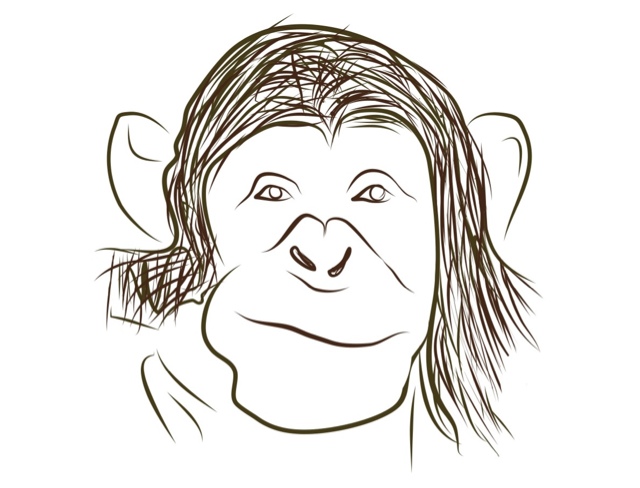
Project Nim, by British film maker, James Marsh, recounts the life of a chimpanzee selected for the privilege of being taught American Sign Language. Removed from his mother when he was two weeks old, Nim was passed from human family to human family at the behest of the psychologist in charge of the research, until he finally ended up in a series of cash-strapped wild animal refuges. Nim learned sign language reasonably well, and then used most of his communication skills to beg for food and urge people to play. By chimp standards, he apparently was not a tremendous intellect, but I must admit I know plenty of humans with similar priorities.
On first impression, the film seems like a balanced view of a controversial time in animal research. The scientists, professors, students and technicians interviewed share their human frailties and unfortunately do not come off particularly well. The first surrogate mother admits to breast feeding the infant chimp; a later caregiver admits to sharing joints with the adolescent Nim. The lead scientist clearly had an eye for the babes at a time when carnal relations between professor and student were not so taboo as today.
In one sad scene, the prof is interviewed on American prime time news, and admits that he considers the 'experiment' a failure. There was no 'Galileo Moment', as one observer put it. We aren't told what the experimenters expected. Did they want philosophical insights into the chimp's dark visions? Did they want Nim to tell jokes? Why did they feel compelled to extract this poor animal from his artificial zoo home and immerse him in dysfunctional human families? Why was this necessary to teach him sign language? There is some mumbling about the hot topic of nature versus nurture, but then, who would do such an experiment with one animal, with no replication? Knowing he would be around human children, menstruating women and family pets, why did they not neuter Nim rather than let his testosterone run wild? By focussing on human failings, the film makers cheat the audience out of the answers to questions about the work, questions most viewers won't realize they should be asking.
The movie brought to mind Sara Gruen's recent novel The Ape House, which I considered a clichéed look at the world of primate research and of science in general. But this movie makes me wonder if I was the naive one. The scientists in this film seem every bit as tunnel-visioned as those in Gruen's fiction. Reading more about the rationale behind the actual Nim project after I saw the movie, the deficiencies in the film itself became clearer. The context of Noam Chomsky's work on the linguistic potential of animals is hardly mentioned. Noam Chomsky... Nim Chimpsky... I'm sure it seemed funny at the time.
When I write grant applications, I check off boxes declaring that reviews of animal welfare, environmental impact or biosecurity are not required. These are always an annoyance; I'm a responsible guy, as are most other scientists I know. After seeing this film, I appreciate more why such reviews are needed.
You have to be careful with documentaries. By hiding behind the viewers' trust, that what the film makers show you is true, it is easy to forget about the cutting room floor. In this film, part of the agenda matches mine: scientists are people too. But there is an insidiousness here, an insinuation that because these are imperfect human beings, that their science is arrogant, misguided and of dubious value. We need these stories, but documentary journalism, like science, should be balanced and should not conceal inconvenient facts.
Saturday, 2 February 2013
Let's Trade!

that they were trying to buy him, or buy us, for their research institution in Shreveport, Louisiana. The boss handed them over to me, laughing dismissively. "If you can convince him," he told his visitors, "then maybe we have something to talk about." In the dream, there was no follow-up. But I considered uprooting my life to another country for money, for my research, wondering if I could find all the dog's vaccination certificates. Then I realized that the work they were buying me to do wasn't the kind of work I loved, and it wasn't really me they wanted to buy.
In the real world of science, this actually does happen. At least one close colleague moved his whole institute from one university to another, to a different city, staff, students and all. More often, it is a single bright young star they are after, someone who has published something big in Science or Nature or Cell during their doctoral work or as a post doc, someone with the potential to bring in lots of grants (lots of overhead) and students (lots of tuition). Cross border head hunting of this kind is less common but for smaller countries like Canada is a part of our brain drain. Few of our research institutions have the big bucks to put together this kind of seduction for our own superstars, let alone those from abroad.
I have often mused on what life would be like if scientists had more celebrity, and the general public obsessed about us to the same extent that they do about athletes or pop stars. Imagine being traded from one institution to another. You would be called into the director's office unexpectedly and told, "We've traded you for Dr. Berlin's latest PhD student, plus future considerations. Go pack your bags." There would then be a press conference and you would say,"I'll miss my fellow scientists here, but I'm looking forward to joining the new department and helping them win big grants. It's the work that matters, not my personal statistics." Then you would hold back the tears, and the flashbulbs would flash.
Even the most banal pop star gets called back for an encore, but this never happens at a scientific conference. We get the question period, which is like giving hecklers their own time slot after a comedy routine. This tradition usually prevents presentations from being interrupted by data hecklers, but not always. I was once heckled at a conference in Hawaii when the projector bulb went out and I decided to keep going, waving my hands around to illustrate what was supposed to be on the screen. "Show us your golf swing!" a distinguished colleague hollered from the back. Sometimes I actually have a few slides after my apparent final slide, in case anyone asks for just a little bit more, kind of a mini-encore.
Like being mobbed by bio-groupies, trades and encores are fun to think about, but I'm not sure they would improve the quality of scientific life. There is no red carpet to walk on our way into the conference hall, paparazzi flocking, no reporters looking for that sound bite. Or at least, not at the conferences I go to. If we were celebrities, most of us would be photographed in that tragic pose that fiction writers seem to favour... we have seen the depths of the universe and it's not looking good. We have to be serious after all, not be clowns in beanies or beefcakes with biceps. Considering how the scientists' image with the public could improve, there are few convincing role models. The media, our media, stereotypes everyone, from politicians to children with leukaemia. It is far easier to use shortcuts to evoke emotions than to tell an honest story and hope people will care. It's far easier to employ innuendo than it is to prove facts. Or so I would have you believe.
Subscribe to:
Posts (Atom)