Monday, 30 June 2014

In the darkroom

Northern lights in northern Ontario, circa 1974
Last week, my treasured print drier was fondly dispatched to the dumpster at the electronic recycle. It hadn't been touched for twenty years and I could not invent an alternative purpose. Back in the day, wet, washed prints were squeegeed onto one of its two shiny, curved, stainless steel surfaces. Then the canvas cover was stretched across to sandwich the photos in place as they were grilled to dryness by the heating elements within. This was supposed to give the print a glossy surface but it was never quite as perfect as the results from real labs. If there was dust or little spots of rust on the platen, if you didn't squeegee the paper perfectly, there would be pock marks, dust or amoeba-shaped dull areas. If you dried the print too long or not long enough, it would curl into a tight cylinder that required reflattening in a heavy book.

I got interested in photography in high school, but never joined a club. It was an expensive hobby if the drug store did all the developing and printing. But the astrophotography I was doing at the time did not lend itself well to commercial processing. The automatic machines and the humans that ran them assumed there must be something wrong with a photo that was almost entirely black. No one could possibly want those little specks and clouds of light to be printed. My father had a talent for satisfying my material whims through the classified ads in the local newspaper. He bought a portable enlarger that disassembled into parts that fit into the small suitcase that was also the base for the stand. A fellow science nerd initiated me into the darkroom arts, the chemistry of developing film and the optics of making black and white prints. It was in theory much cheaper than paying for professional developing, but there was so much waste because of over-exposures and under-exposures and experiments with filters and different papers.  The mixing of solutions in narrow plastic cylinders marked like measuring cups, calculating concentrations, pouring liquids into trays or tanks where they would work their reactions, nourished the incipient chemist in me. 

Exposed film had to be handled in complete darkness. My father and I chose his workshop, covered the windows with heavy blankets and stuffed towels under the door. We worked only at night, but there was always some faint glow. Sometimes I retreated into a closet. Hiding in the darkest possible corner, I pried open the film with a can opener and pulled out the roll, hoping not to drop it onto the floor. Film had to be wound onto the developer spool following the generally imprecise clues provided by fingers and imagination. I cut off the end of the film and tried to feed it into the outer slot, then pushed it through the spiral track towards the centre of the spool. If you messed up, loops of film would stick to each other, the chemicals wouldn't penetrate evenly, and the film would be spoiled. 

At the university residence, there was a well equipped darkroom beside the auditorium. The dorm was my first opportunity to interact with girls away from the judgmental eyes of my parents and older sisters. Girls were terrifying and I had no idea how to talk to them. I practiced imaginary conversations, but real conversations somehow never went as they were supposed to. A few girls were intrigued enough by the process of DIY photography to enter the darkroom alone with a tutor and watch a demonstration. Perhaps they misunderstood the meaning of the term 'safe light', the bulb that lit up the room with a wavelength invisible to print paper. It allowed us to see what we were doing in a flattened, red tinged black and white sort of way, as we made our prints. My room mate had the charm to pull off, "Let's go into the darkroom and see what develops," without causing offence. He also had a telephoto lens on his camera, which he used to take photos of girls in bikinis on the beach in the summer. For me, it was stumbled and mumbled invitations to equally shy girls and avoidance of any eye contact. At least I didn't have to think much about what to talk about and under the red light no one could tell I was blushing. "This is the developer," I would say, as I slid the sheet of paper exposed in the enlarger into the first bath. And then we would share the wonder as the image emerged, like a ghost coalescing from the liquid and solidifying on the paper. Poetic words were unnecessary. The magic was in front of us. And then the print went into the stop bath with its urine colour and vinegar smell.

At my first lab job, there was a professional darkroom connected to the electron microscope centre. It took some persuasion to be allowed to use it, but I was writing my first scientific paper and had a plate of black and white photographs to prepare. The electron microscopy technician supervised, a tall man with owlish glasses, who seldom said anything. We made the prints and began the finicky process of cutting them into perfectly squared pieces of exact sizes. To assemble the plate, the five individual pictures were attached, one at a time, to a piece of double sided waxed paper using an iron, so that the white spaces between each photo were perfectly even. It took forever and luckily we had lots of duplicates of each picture. I thanked the technician profusely for his help. "I'm an alcoholic," he told me. "Every day is a struggle." Then he demanded an acknowledgement in my paper because it was important for his job security. 

Nowadays, most lab darkrooms are used for transilluminators, with ultraviolet lamps to light up strands of DNA in gels, to be photographed by ultra-sensitive digital cameras. Most students have never used a darkroom for its original purpose. I love digital photography and the marvels of computerized editing, and don't miss gluing plates of photos together for publication. My enlarger-in-a-suitcase sits in the basement, along with brittle plastic graduated cylinders, oversized forceps, and expired bottles and sachets of chemicals. But I miss the chalky smell of fixative and the comfort of the reddish black shadows. Just as purists insist that digital music is inferior to vinyl, the dwindling population of darkroom enthusiasts prefers analog. But not me. The illumination that photography brings to our world no longer emerges from darkness, but from computer monitors. But the journey of the our imagination stays the same, as we snap images and shape them into visions that we share with the world.

Sunday, 8 June 2014

The dissection kit


In second year, all biology students had to buy a dissection kit. It was sold at the campus book store, alongside the texts, notebooks and pens and cost about $25. Engineering students bought complex calculators or slide rules, chemistry students the Handbook of Chemistry and Physics, but for us it was scissors, scalpels, blades, tweezers and plastic-handled needles. One enigma was the 'probe', a metal handle with a bend near the end, with a rounded or recessed tip. What was it for? The word 'probe' was so provocative.

We all carried our identical baby blue plastic cases full of identical tools, in a time when permanent laboratory markers were still imperfect. Students customized their boxes with unscientific magic markers and stickers. My sister, a veteran of the same course, sewed me a custom case of lurid red vinyl-like material, which rolled closed and was held together with strips of Velcro, and ensured that my tools would stay separate from everyone else's. There were abundant narrow slots for additional implements, so I could stock up if the opportunity arose. I don't remember permanently borrowing anything from anybody, but somehow the kit expanded with pins and clamps, holders and blades, simply because there were spaces for them.

This was the final year that premeds mingled with those who only wanted to be biologists. They shoved us aside in the teaching labs, eager to hone their tissue slicing skills while the rest of us tried to avoid opening the velvety bellies of white mice. We started with earth worms and frogs and graduated to cow's eyes, stiff, plank-like mink and eventually dog fish. Several companies sold preserved cadavers specially prepared for the classroom, with veins injected with rubberized blue paint and the arteries with red. Larger animals were preserved in formaldehyde, a stench that bonded to hair and clothes. Dissecting these elastic, oozing tissues was tricky despite the sharpness of the scalpels and the power of the scissors. There was only one time that we were required to handle warm tissue. Lab rats were 'sacrificed' in the name of science, so their livers could be harvested in a physiologically active state and we could isolate mitochondria. Teaching assistants did the deed in another room, away from our sensitive eyes; one TA admitted that he hated his job that day. I let my lab partner, a curly haired blond named Steve, remove the rat's liver with his own scalpels and scissors so that my own would remain innocent.

The end of the term featured the dreaded lab exam. We circulated from one bench to the next, allowed two or three minutes per station to answer a few questions about ducts or muscles indicated by coloured pins. The premeds sometimes slyly shifted the markers around so that no one after them would get the right answer. 

Although it did not often serve its intended purpose, my dissection kit has now followed me for 37 years, mutating as I've moved from lab to lab, adapting to what I really need it to do rather than what it was originally intended to do. The original scissors are now used to trim my finger and toe nails, cut paper, and prune plants. I guard them ferociously because they are fantastic and I would never be able to find a better pair. Like any good biological system, they have reproduced and there are now two pairs of scissors, one at home and one in the lab. I'm not sure where the second pair came from or which is the original. The forceps also multiplied, overflowing the original case into trays in the lab and racks in the workshop downstairs. Sometimes I use the scalpels and forceps on myself, sterilizing them with alcohol, taking advantage of the high quality microscope optics at my disposal to remove slivers from my fingers.

As students and post docs filter into my lab from different cities, provinces and countries, it is fascinating to to see what their dissection kits hold. The collections all start out the same, but evolve in symbiosis with the interests, needs and manual dexterity of their owners. One colleague mounted his own thick, oriental eyebrows in metal handles for handling fragile microscopic structures. One student donated special microscalpels used for retinal surgery to my own kit. 

The first paintbrush and colour pallette, the first violin, the first baseball mitt, these are all tools that take us from a world of dreams and possibility to a world of work and accomplishment. My dissection kit and its tools are extensions of my hands and my mind. May you find the same.

Friday, 23 May 2014

Baby brain


You have to be cautious when talking with scientists about art, or with artists about science. My opinion is that they are actually the same thing, expressions of the human quest to expand our understanding of the universe.

This photograph is the plaque at the entrance of the Montreal Neurological Institute at McGill University commemorating its 1953 opening. It seems about perfect to me, as art or as science. The motto beneath it: Where shall wisdom be found and where is the place of understanding?

Monday, 12 May 2014

Road kill


A peculiar complacency overcomes many scientists after a time. Lab safety is drummed into us from the beginning. There are basic things, like don't pipette deadly pathogens by mouth, don't add water to concentrated acids. Most of us pay close attention to hazards that might affect our reproductive success while we are still of the age when it matters, but otherwise a subconscious slackness slides in, as if we have been exposed to certain dangers so often that we are now immune. One of my colleagues swims in the slimiest water imaginable and has no hesitation about harvesting dead animals from the side of the autobahn for his evening meal. As a microbiologist, perhaps he expects that the passion he feels for the natural world will prevent it from attacking him. The same man watches birds as he drives along winding roads and alongside cliffs, confident that because he loves nature, crashing into a tree or into a lake full of fish would be impossible.

A cloud of regulations surrounds labs so that workers aren't exposed to explosions, noxious gases cannot escape to threaten the general public and toxins do not ooze into the environment. Ethical protocols ensure that humans and other animals are treated compassionately when they are the involved in research. To get around these awkward restrictions, some scientists experiment on themselves. When I was a grad student, one prof who clearly had no hesitation about investigating the effects of certain botanicals on his nervous system, extended these prosaic tendencies into his research on light-activated compounds with potential for cancer therapy. He scratched his arms with novel chemicals and climbed onto the roof of the biology building, holding his arms up towards the sun as if he was on a crucifix. He recorded the rashes and itches and boils in his lab book, along with happier results where he had no adverse reaction at all.

These memories returned as I listened to a radio interview last week with a graduate student at Cornell, who experimented on himself to find out which parts of the body hurt the most when stung by a bee (it is the tissue dividing the two nostrils). The interviewer (in common with most of the scientific press) was most interested in discussing why this man allowed a bee to sting his genitals, apparently unaware of the proud, if loopy, scientific tradition of self-experimentation. Sir Humphry Davy, for example, the man who gave us what eventually became the first medical anaesthetic, nitrous oxide or laughing gas, was systematic in studying the effects of breathing in various gases on his own body. He almost killed himself trying to establish the toxic dose of carbon monoxide.

Undoubtedly, many scientists have done themselves in or doomed themselves to disability in the pursuit of knowledge, out of sheer laziness, or in attempts to bypass bureaucracy. As for me, I've had a few accidental pokes in the skin that I'd have better avoided, and probably inhaled a bit too much benzene in my student years. But I haven't had much interest in using my own body as an experimental apparatus. This might label me a coward, but I'd rather be safe on the narrow path of science than road kill in the ditch.

Saturday, 19 April 2014

Dry run


It was a lab rule that anyone giving a talk had to have a practice run with the prof. This was supposed to be one on one but when my turn came, it didn't work out that way. Dr. L. was in deep denial about computers, but always wanted to impress colleagues with his state-of-the art knowledge of the latest technology. My talk had to use some LINUX presentation program with vertigo-inducing animation capabilities that Dr. L. found on a CD-ROM in some old magazine. And this meant that Dennis had to be there for the dry run. He could run any program on any computer. He had bytes in his fingernails.
          "Now Peter," Dr. L told me as I was ready to start. "This is your first conference presentation. I want you to be well prepared. Don't be frightened, but the crowd at some of these meetings is like a hoard of vultures, just waiting to tear meat from your limbs. Especially Kowzlowski... that cow. You've got to look sharp."
          "Uh, okay," I said, glancing over at Dennis, who gave me his finest gap-toothed smile. "Can I begin?"
          "Please do."
          The computer was balanced on a stool wheeled in from the lab. "Well, here's my first slide."
          "Is that how you're going to start?"
          "No, I was just..."
          "Say it how you're going to start."
          "Good afternoon, ladies and germs. My topic for my presentation..."
          "Hold on. Ladies and germs?"
          "They're microbiologists. It's a joke."
          "No it isn’t. Don't tell people what the topic is. They can read."
          "I'd like to talk about the results from my first year of thesis research..."
          "Dennis, I don't like the background on that slide. Is it green?"
          "No, it's red," Dennis answered.
          "Let's try it blue."
          "No problem." Dennis clicked the mouse around on the stack of journals that was the most uncluttered horizontal surface in the room. I realized then that the dry run of my ten minute talk would last at least two hours. None of the slides were right, they either had too much text or not enough. He didn't like the bullets... we had a ten minute discussion on whether they should be round or square. And he wanted me to refer to more of the lab's previous results in the discussion.
          "Okay, that's not bad, Peter," he said when I finally reached the end. "Now, let's see if you can handle the questions. Let's see... Dennis, can you think of anything?"
          "No," Dennis answered. He looked so much like some hippified version of Alfred E. Neumann, I had to laugh. He often used imaginary words and made cartoonish sound effects. This time he just gave me a wink.
          "What kind of question would that Kowzlowski ask?" Dr. L. wondered. "That cow. I know. In your fifth slide, weren't the correlation coefficients too low for you to make such sweeping statements about the relationships between your variables?"
          I glanced warily at Dennis. In addition to his Luddite approach to computers, Dr. L. was known for his utter ignorance of statistics. "That's a principal coordinate analysis," I told him. "I didn't do any correlation analyses."
          It was nearly four when we escaped. "I don't know what I'm going to do," I told Dennis. "He made you change every slide. I’ll have to relearn the talk, it's all different and I'm speaking tomorrow."
          "Don't worry. I saved the originals. You could never use the new ones... he's colour blind, didn't you know? I was just humoring him. Have you ever seen him talk? Holy neeble. You'll be fine as you are. But Kozslowski's going to have you for breakfast."
          "Is she really that bad?"
          "I've never met her but he's been ranting about her for years. The happiest I've ever seen him is the day he got one of her manuscripts for review. As far as I can tell, her lab does exactly the same work that we do, but they use a different bug."
          "I don't know, Dennis. I just want to concentrate on presenting my data. How bad can she be?"

          Celia and I handled the registration table the next morning. It was strange to suddenly have faces to match the names I'd known only as authors of papers. No one looked like they should. Dr. Needles was short and balding. Dr. Reid, who often wrote long, ponderous sentences full of vaguely alien syntax, turned out to be a woman. I half expected Dr. Kozslowski to be a rotund lady with a large nose, corresponding with Dr. L's nickname for her. Perhaps she would even be wearing a white dress covered with large, black spots.
          "Peter!" Dr. L. half-shouted at me, panting and red faced. "It's getting hot in here. Go see if you can find some air conditioners. Celia can handle the desk."
          Dr. L. was notoriously frugal and had booked the cheapest room on campus. He hadn't anticipated a heat wave at the beginning of June. I searched from lab to lab, accompanied by some undergrad muscle. No one wanted to part with their portable air conditioners, but we scrounged four units from our own lab and one of the teaching labs. When we got back to the conference room, the first session was already underway. They had opened the windows and turned on some fans to set up a cross breeze. A nervous little man with an Australian accent was finishing what had obviously been an awkward presentation. He was using overheads for visuals; gusts of wind kept blowing them off the projector onto the floor.
          "How's it going?" I asked Celia.
          "Kozlowski lit into Dr. L. after his opening monologue. Claimed he didn't acknowledge her as the first discoverer of the Q factor."
          "Which one is she?"
          "I don't see her now."
          My talk was first after the coffee break, and I tried to simultaneously calm and psyche myself with all that familiar advice about giving seminars:
          a) Check your fly before going to the podium.
          b) Check your hair in the mirror for cowlicks.
          c) Don't wash your hands in case you accidently splash water on your trousers.
          Dr. L. introduced me and there I was, trying to remember my opening lines. They had forgotten to plug in the laptop, of course, and the battery died just as I was about to begin.
          d) Always smile at the audience.
          All my Milton Berle jokes evaporated as I waited for the title slide to appear. Two or three people fussed around the computer while two or three others rushed over to stop one of the air conditioners from tipping out of the window. At last, the screen came to life, and I launched into my maiden speech. I can hardly remember anything I said. It seemed like someone else speaking. I watched the overheated, jet-lagged delegates struggling to stay awake, a few rocking side to side, suffering the diuretic effects of too much coffee.
          A hand was up in the audience. The chair nodded, and the woman asked, "Can you relate your results to the oppression of the women in patriarchal societies or the fall of the Berlin Wall?"
          "Pardon me?" The questioner was a petite woman with a strong New York accent. Short brown hair, kind of pretty beneath the thick glasses.
          "What I mean is, is this work actually relevant to anything? Does it have any significance to the plight of humanity on this planet? You haven't shown us anything we don't already know..."
          "This is only preliminary data. I'm just starting my thesis, there's still two more years to go..."
          The woman snorted and folded her arms. Everyone seemed to be alert and embarrassed. Finally, someone at the back of the room put me out of my misery with a banal question about the number of replicates in one of my experiments.
          I sat down. I had lost my scientific virginity. Instead of feeling excited and fulfilled, I had been a sacrificial lamb to a vampire cow.

Thursday, 20 March 2014

Parking for the elite


Today, I'm on the campus of the University of California, Berkeley, number six on the list of institutions with the most Nobel Prize winners. I wanted to know if there were statues or monuments to honour these famous people. The reply was that laureates are offered a choice of having a building named after them or their own permanent parking place, and that they all choose the parking space. Here are some of them are in front of the Physics Building on Oppenheimer Way. Notice that the display of a parking permit is required to prove status. Such permits probably don't help them find parking at the grocery store, where expectant mothers are far more important. Very few of the laureates are at work today. They must have heard I might be dropping by.

Monday, 17 March 2014

Sitting ovation


Perhaps as an expression of some latent compulsive behaviour, I tend to count things. So I can tell you with certainty that at a typical scientific conference or seminar in my field, audience members clap their hands an average of 13 times as their contribution to the applause. It may be a coincidence that the average grapefruit has 13 segments. Perhaps a fully developed grapefruit should have sixteen segments (the sphere divided by 2 by 2 by 2 and then 2 again), and three tend to abort. Whether there is a correlation between applause for scientific presentations and grapefruits segments, I leave to your imagination and creativity with freakish statistics to explore.  

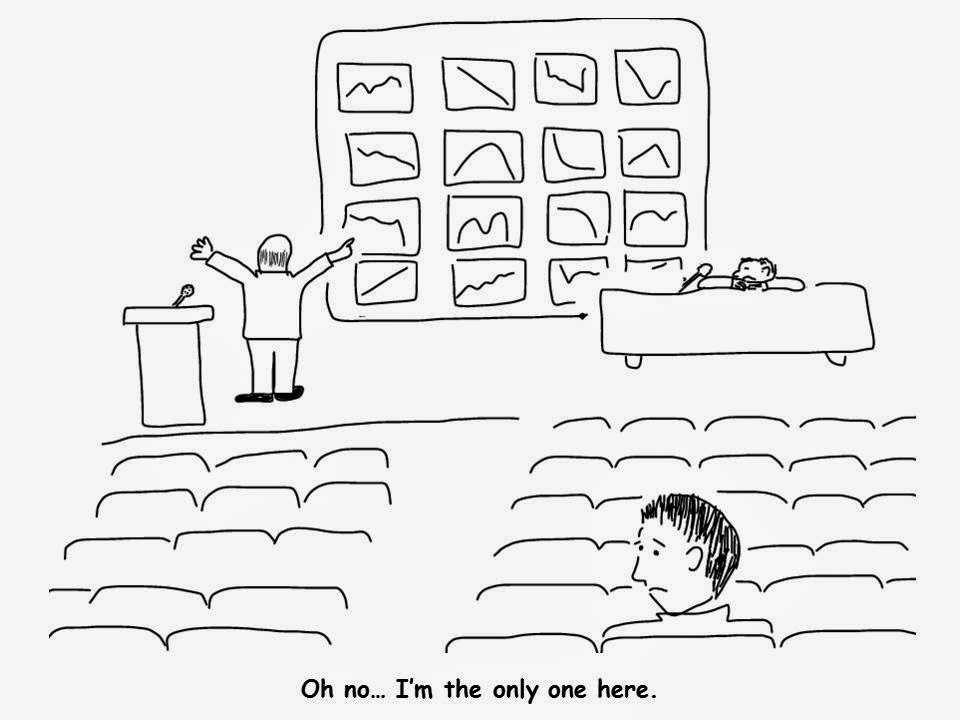
We were at a concert recently in a small club, and the warm up act got about 26 claps after every song. This is twice as many as a seminar and it happened after every song, so every five minutes or so. Last night, the main act got 26-36 claps after most songs, and as many as 50 to reward those special moments. The only logical conclusion is that if you crave generous applause, be a musician and not a scientist. Imagine a world where the audience claps at the ends of the Introduction, Methods, Results and Discussion of every research presentation, and goes wild over a particularly astonishing graph. This could be disruptive, but we'd get used to it. 

Research seminars range from about six minutes long in intense specialist conferences to 45 minutes for keynote or banquet speakers. My longest talks have been university lectures, where I might drone on for 80 minutes while students surf the Internet or send Tweets that I fortunately never have to read. I'm just a guest lecturer and nothing I say ends up on their exams so all they need to do is sign the attendance sheet. They sometimes applaud out of some sort of vaguely perceived pity. About six claps, twice as many as that most sarcastic of applause, three staccato claps.

A scientific analysis of applause was published last year. The authors compared the spread of clapping to a 'social contagion'. In other words, applause spreads like a virus, with one or two people infecting everyone else, and after the appropriate time, the applause dissipates in the reverse way. Perhaps it is only a matter of time before some scientist employed by some megalomaniac politician engineers a virus that can be released on unsuspecting crowds to increase clap counts.